

Building a Scalable, Values-Driven Restaurant Brand
How an East Coast investor and a West Coast operator launched Guapo Taco


Juan Carlos slices mango at dawn.
These quiet mornings before school have become a ritual for him and Luna. The mango is for Luna and he slices jicama for himself, sometimes with a homemade tajin-inspired spice blend. Luna only likes the spice on Thursdays–kids. These mornings didn’t exist before but things have changed for Juan Carlos.
He no longer writes every prep list or drives the van because Desert Rose Tacos operates without him. Not flawlessly, but independently. He plays the role of Tío—trusted, present, but not a linchpin.
That shift didn’t happen by accident. Two years ago, Juan Carlos made a decision to build a business in service of the life he wanted. He wanted mornings like this. He got there by defining his values, hiring people who shared them, and creating standards, and delegating responsibilities.
The culture inspired by his time in the kitchen with his grandmother is palpable. Employees live it and people eating their food feel it and, at a wedding one night, so did Darby–a real-estate investor from New England.
She’d obviously had a few spicy margaritas, but her Boston-accented pitch was direct: “I want to open a taco shop in Massachusetts. Like a taco truck crammed into the smallest brick and mortar footprint we can find. I don’t want people hanging out for long, so no chairs, just a few bar counters to stand at.”
She called it Guapo Taco.
Juan Carlos assumed she was tipsy and would forget the idea. He handed her a business card and returned to service.
She was indeed a little tipsy but she didn’t forget.
A few weeks later, Darby called Juan Carlos.
“I found a shuttered Dunkin’ in Worcester. It’s a college town with potential and a great place to test a proof of concept for the brand,” Darby excitedly shared with Juan Carlos.
“I know this is fast but it’s how I work. Bring your family to New England and see for yourself. The trip is on me.”
It's the dead of winter in Massachusetts. Juan Carlos packs snow boots for Luna and skepticism for himself. The old coffee shop is beige and tired but Darby sees something he doesn’t.
“Cambridge, Medford, Providence—all of them are wide open,” she says. “If we can prove the model here, I’ve got a network of potential investors to open more locations. I’m ready to fund Worcester and bring you on as an operating partner.”
They retreat to a cozy bagel shop nearby.
Juan Carlos finally asks what’s been on his mind since she first called: “What does proof of concept mean?”
Darby doesn’t pull herself away from the coloring book she’s sharing with Luna.
“It’s like a tester site that proves our idea is a good one. There should be team performance without you on site. Operational consistency from shift to shift and, eventually, location to location. And, predictable margins I can show to investors.”
Juan Carlos nods but is still unsure. It's a new language to him and he doesn’t fully understand.
He remembers how much he carried in the early years of Desert Rose and how long it took to pull the process out of his head and put it in the hands of other people.
“So what does partnership mean?”
“I’m not here to run a restaurant,” she says. “I’m funding the first one. I’ll help shape the bigger vision and make sure what we build is fundable. But the day-to-day? That’s your lane. You’re the operator.”
That’s what he’s good at but Guapo Taco can’t be built off instinct like Desert Rose was. It needs structure from day one.
“So,” Darby asks, “where do you want to start?”
Juan Carlos doesn’t hesitate and leans in.
“With Immutable Laws,” he says. “They're our foundation.”
They book a Zoom for two weeks later, post Luna’s drop-off at school. Juan Carlos plans to draft a set of values based on Darby’s initial vision that can guide decision-making for years to come.
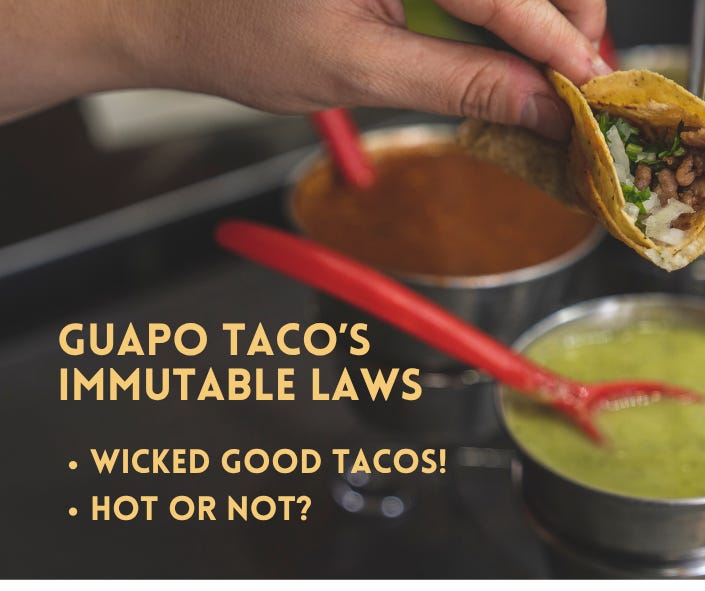
Over a few Zoom sessions, they refine Juan Carlos’ ideas into two crisp values. The partners agree the Immutable Laws are values a brand can be built on and as a bonus they would look really cool on t-shirts and stickers.
Wicked good tacos! The wicked good quality of our food is our brand. Not our service, not our plates, not our vibe. If it’s not wicked good, we don’t serve it.
Hot or Not? We limit our menu at Guapo Taco so we can execute on our promise–wicked good tacos. Our recipes are Hot! Our communication is Hot! If something or someone gets in the way of our promise, it's Not for Guapo Taco.
Juan Carlos also shares a tight menu: four protein options served as tacos or quesadillas. The garnishes are simple—lemon, cilantro, onion. Salsas? Just two: Hot or Not.
Darby trusts the food. What she wants now is assurance of scalability.
“I’ve had your tacos. They’re wicked,” she said. “But let’s talk about the non-sexy stuff. The parts that make this replicable.”
Juan Carlos nodded. “We need a person to lead and people to make the tacos. A playbook of what to do and how to do it.”
“Let’s start with people, then,” Darby said. “Afterward, we’ll get into the how. But seriously, let’s hear more about those salsas…”
People First: Building a Path Forward
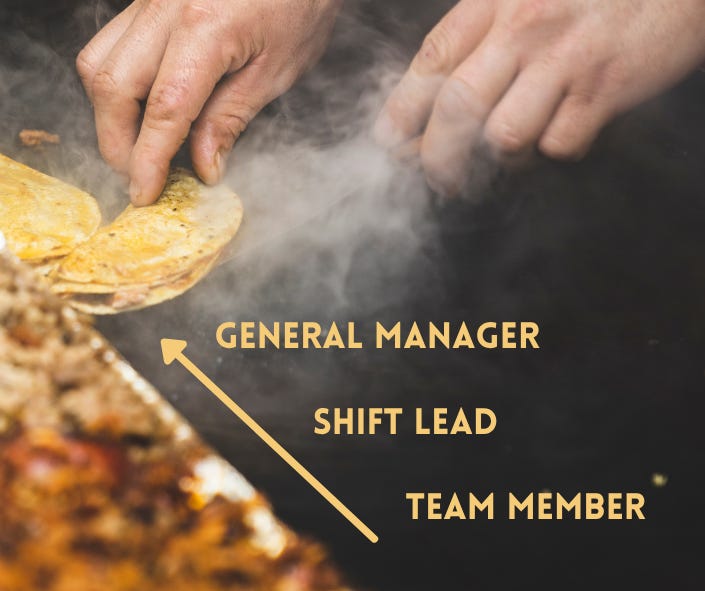
Juan Carlos knows the systems have to support the people. He just finished reading The Ins-n-Outs of In-N-Out, and one idea stuck: an employee-driven company. A place where team members could grow from cashier to general manager. That’s what he thinks Guapo Taco needs—a growth path that rewards curiosity and commitment.
He starts with structure:
General Manager: Responsible for labor, inventory, vendor relationships. But more than a scheduler–a culture steward.
Shift Leads: Cross-functional leaders who manage pace, prep, and service. They open, close, and coach. Some will be future GMs.
Team Members: Trained across service and prep. Everyone learns every station and has an opportunity to grow.
Each step is supported with role checklists, mentorship, and quarterly reviews. After 90 days, team members could opt into a Leadership Candidate track.
“The right person can be a GM in two years,” Juan Carlos tells Darby.
Building the Playbook: Making It Repeatable
Juan Carlos learned his lesson after years of carrying the weight of Desert Rose Tacos. Institutional knowledge cannot live in one person’s head.
So this time, everything goes into playbooks designed for the people actually doing the work. Standard Operating Procedures (SOP) aren’t designed to be overbearing controls, they’re designed to reduce the mental load an employee carries so they have the opportunity to show up their full self everyday.
Three categories form the How My Restaurant Works system:
Strategy SOPs
Profit and Loss reports that serve as tools (thanks to Darby’s consultant, Ruth) with a financial workflow that makes them possible. An aligned concept, menu, and marketing plan.Operational SOPs
Opening and closing routines. Inventory triggers and laminated checklists in the prep room. Shared drives for equipment and facility maintenance resources. A tech stack that serves Guapo Taco, not just the most popular point-of-sale system.Team SOPs
A Day One video that explains Guapo Taco’s Immutable Laws and intentions followed by an onboarding calendar. Hospitality training and leadership check-ins.
Three Months Later: A System in Motion
The Worcester community questioned the “no chairs” model at first but the college crowd caught on fast. The line’s steady and late-night rushes are borderline iconic.
And the tacos? Wicked good.
Juan Carols overhears that a majority of the diners prefer the Not salsa but the Hot offering is slowly building a following. Darby is already suggesting bottling the salsas to sell.
Success isn’t just in the wicked good tacos. It’s what happens when Juan Carlos walks in at 8 p.m. on a Friday and isn’t needed on the line. Orders are going out efficiently considering the line is out the door. The shift lead with a new hire shadowing her has been asking about the Leadership track. The GM is joking with a diner who should have opted for the Not salsa.
The shop was humming. The cracks that surfaced were behind the counter, out of view of diners.
The day before one of the ovens stopped working during the morning’s prep shift, the GM panicked. They hadn’t faced an equipment failure yet, and no one knew who to call. Juan Carlos was looped in and managed to track down a local repair company that could dispatch a technician ASAP. Crisis averted but he realized he should’ve been prepared for this.
Afterwards, he seized the opportunity as a systems check.
He added a shared maintenance log to the shared drive, with serial numbers, purchase dates, and emergency service contacts. He contracted a dishwashing company for ongoing service and repairs and urged the GM to start building a stronger relationship with the linen provider.
Some issues don’t have solutions until they show up but once they do, they become part of the system.
At Guapo Taco, systems aren’t just about efficiency to scale—they’re about care and support.
A prep list isn’t just a checklist. It’s a clear definition of a team member’s role, a promise that no one has to guess what’s expected of them. That clarity is what frees people up to grow, and if they work hard for a long time, to eventually sleep in and slice mango at dawn before taking their kid to school.
No restaurant is truly hands-off, but it can be hands-off from the right things. When roles are defined, expectations are shared, and decisions are guided by Immutable Laws, owners can focus on building the future and not putting out daily fires.
That’s the difference between carrying a restaurant on your back and building one that carries itself.
Tactical Challenge
Write one SOP. Start small. Use this BOH Opening Checklist as a template. Make a copy and customize it for your team but don’t write it alone! Ask your team what it actually takes to do the job well. When you build systems with your people, not for them, those systems stick.
Amazing
Amazing! Thank you so much for sharing this.